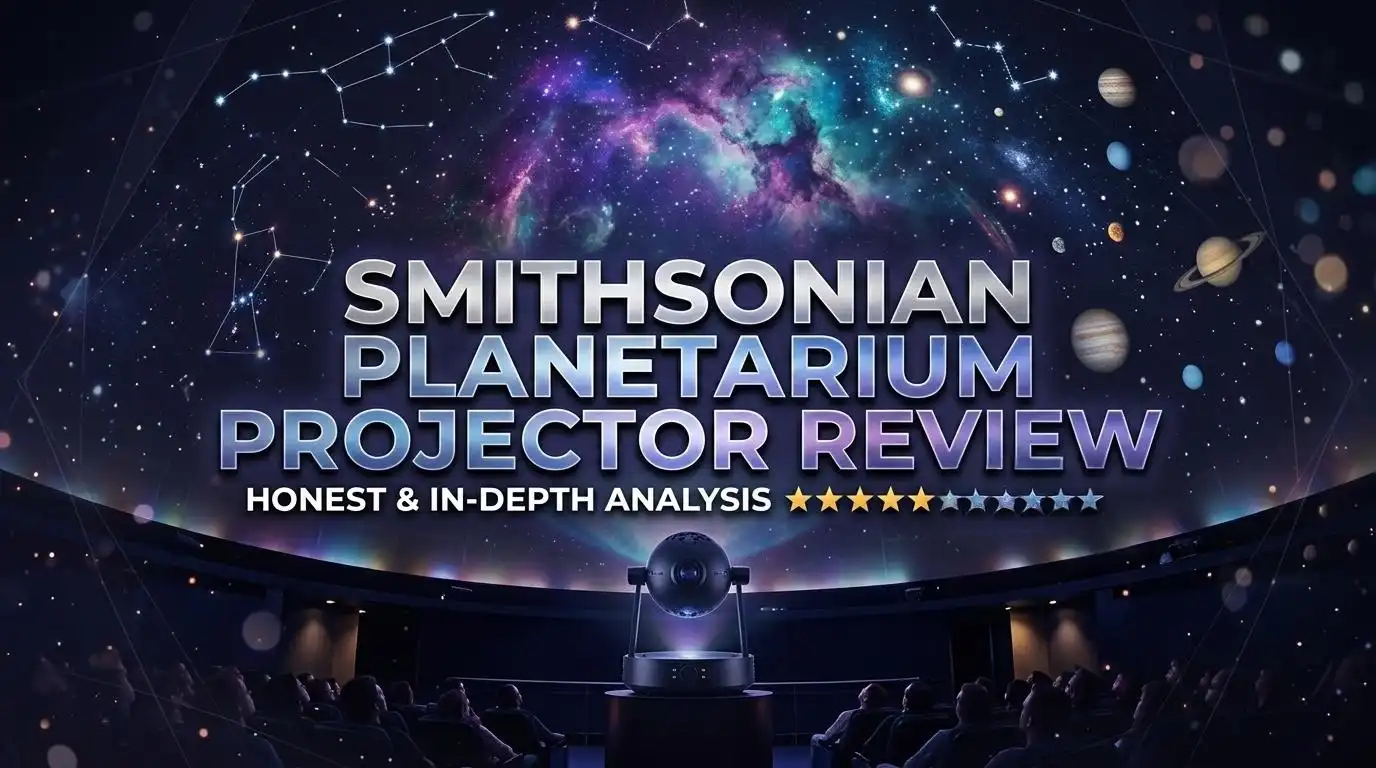
Stargazing from your bedroom sounds like a dream. The Smithsonian Planetarium Projector turns that dream into a nightly routine. Parents love it. Kids adore it. Teachers recommend it for STEM learning at home.
This 2026 review covers every detail you want to know before buying. You will learn about the features, image quality, setup, and real value. We also compare it with three popular alternatives that compete in the same price range.
Star projectors have grown more advanced in recent years. Yet this classic model from Smithsonian still holds a strong place on Amazon best seller lists. Let us find out why this device continues to win hearts in 2026.
In a Nutshell
- Dual function design: The unit works as both a rotating star projector and a slide image projector showing 24 high definition space photos.
- Educational value: It comes with a STEM learning booklet that teaches kids about constellations, planets, and deep space objects.
- Easy to use: A simple knob and switch system means children as young as six can operate it without help.
- Auto shut off feature: A built in 15 minute timer lets kids fall asleep under a moving night sky safely.
- Affordable price: It costs much less than premium planetariums while still delivering a fun and educational space show.
- Portable build: It runs on batteries, so you can move it from room to room without cords getting in the way.
What Is the Smithsonian Planetarium Projector?

- Planetarium projects moving images of constellations, galaxies and more on your ceiling!
- Projector projects 24 images of galaxies
The Smithsonian Planetarium Projector is a two in one space device for children and families. It projects a rotating star field on your ceiling. It also displays 24 still images of planets, galaxies, and space scenes.
The product carries the trusted Smithsonian brand name. This brand is known for science based educational toys. The projector reflects that mission with accurate space content and kid friendly controls.
You can switch between two projection modes with a simple turn of the head. One side shows the northern hemisphere sky. The other side shows full color slides of cosmic wonders like the Helix Nebula and the International Space Station.


The device runs on four C batteries. It also includes a learning guide for parents and teachers. This guide explains each image and helps young learners connect with real astronomy concepts.
Design and Build Quality
The projector has a chunky and rounded shape. It feels solid in the hands of a child. The plastic body holds up well against drops and bumps that often happen in kids rooms.
Two large dome heads sit on top of the base. One dome holds the star map. The other holds the image disc. You rotate the unit to choose which side faces the ceiling.
The base has a wide footprint. This stops it from tipping over easily. The control buttons feel firm and easy to press. Even small fingers can use them without trouble.
The color scheme stays neutral with black and silver tones. This makes the projector blend into any bedroom decor. It does not look like a typical loud and colorful toy. Parents appreciate this clean design choice.
The unit weighs just over one pound. Kids can carry it from the living room to the bedroom on their own. The build feels durable enough to last for years of nightly use.
Image Projection Quality
The star side projects a rotating pattern of the northern sky. The dots look like small blue points on the ceiling. Some reviewers wish the stars looked brighter and sharper. Still, the slow rotation creates a calming bedtime feel.
The image side performs much better. The 24 photos come from real NASA and Smithsonian archives. You see crisp pictures of Saturn, Jupiter, the Moon, and far away galaxies.
Image sharpness depends on focus and distance. You adjust the focus ring on the dome to get a clear picture. Place the projector about six to eight feet from the ceiling for the best result.
Room darkness matters a lot. The brightness works fine in a fully dark room. In a partly lit room, the images appear faded. Turn off all lights for the full effect.
Colors stay true to the source photos. Reds, blues, and purples of nebulas show up nicely. Kids often ask questions about what they see, which sparks great learning moments.
Educational Value for Kids
Smithsonian builds this product as a learning tool first and a toy second. The included booklet explains every slide image in simple words. Kids learn what each planet looks like and where it sits in the solar system.


The star map teaches basic constellation patterns. Children can spot the Big Dipper, Orion, and other famous shapes. This builds early interest in astronomy.
Teachers use this projector in classrooms too. It works well for small group science lessons. The slide images can support topics like space exploration, the solar system, and stars.
Parents report that bedtime routines turn into mini science classes. Children ask about black holes, comets, and far away worlds. These talks build curiosity and vocabulary at the same time.
The age range fits children from six to twelve years old. Younger kids enjoy the visuals. Older kids dig into the science behind the images. This wide appeal makes it a smart family purchase.
Top 3 Alternatives for Smithsonian Planetarium Projector
If the Smithsonian model does not match your needs, these three options offer great features at similar or higher levels of quality.

- Unveil the Stars Like Never Before: Experience the cosmos in stunning detail with our next-generation high-transparency...
- Promote Restful Sleep with Gentle Lighting: Designed with your well-being in mind, the POCOCO Galaxy projector is perfect for...

- Project 60,000 twinkling high definition stars onto your rooms ceiling or wall
- Christmas 2021: Order till Friday December 17 and usually receive in time.

The Pococo Galaxy Star Projector offers high definition optical film discs and a soft glowing nebula effect. The Sega Toys Homestar Flux is a premium choice that projects up to 60,000 real stars with stunning sharpness. The Orzorz Star Projector sits in the middle range with replaceable discs and a sleek modern design.
Setup and Ease of Use
Setup takes less than five minutes. You open the battery cover and slide in four C batteries. Then you turn the power knob and aim the dome at the ceiling.
The controls stay simple. One switch turns the unit on. Another switch picks between continuous mode and timed mode. A small dial controls focus.
Changing the slide discs takes only a few seconds. You twist the dome cover off, swap the disc, and twist it back on. Kids can do this step without adult help after one practice run.
The auto shut off feature is a smart touch. The unit powers down after 15 minutes of use. This saves battery life and prevents the device from running all night.
No app is needed. No screen is needed. No internet is needed. This makes the projector a refreshing screen free option for bedrooms in a tech heavy world.
Battery Life and Power Options
The projector runs on four C cell batteries. Batteries are not included in the box. This is a common complaint among buyers. Plan to buy batteries separately when you order the product.
Battery life lasts for many nightly sessions. Most families get four to six weeks of use before needing new batteries. The auto shut off helps stretch that time even further.
There is no USB or wall adapter option built into the device. This keeps the unit fully portable. You can take it on camping trips, sleepovers, or to grandma’s house with no plug worries.
Rechargeable C batteries work fine in this unit. Many parents use rechargeables to cut down on long term cost. This is a smart move for daily users.
The lack of a power cord also means no tripping risk in a dark bedroom. Kids can place the projector on a nightstand without any cable management worries.
Sound and Atmosphere
The Smithsonian Planetarium Projector runs silently. There is no fan, no motor noise, and no clicking. This silence helps kids fall asleep without distraction.
Some competing units include built in sound or Bluetooth speakers. This model does not. If you want music with your star show, you will need a separate speaker.
The slow rotation of the star dome adds a gentle visual motion. The effect feels calm and dreamy. Many parents say their children fall asleep faster with the projector running.
The lack of sound is a feature in itself for some families. Quiet bedrooms support better sleep. Music can sometimes overstimulate young kids before bed.
For families who want sound, just play soft music from a phone or smart speaker. The projector visuals pair well with space themed soundtracks or white noise apps.
Who Should Buy This Projector
This product fits families with kids between six and twelve years old. Younger kids enjoy the colorful images. Older kids enjoy the science learning angle.
Gift givers love this projector. It works as a birthday gift, holiday present, or back to school surprise. The Smithsonian brand name adds a sense of quality that pleases parents.
Teachers and homeschool families also benefit. The slide images support science lessons about space, planets, and stars. The price point makes it easy to buy multiple units for a classroom.
If you are an adult who wants a serious star projector for your own bedroom, look at the Sega Homestar Flux instead. The Smithsonian model is built for kids and learning, not for realistic adult stargazing.
Budget conscious parents will appreciate the price. You get an educational toy that also serves as a calming night light. That dual use adds great value for the money.
Pros and Cons Summary
Every product has strong points and weak points. Here is what stands out about the Smithsonian Planetarium Projector after honest testing and review.
Pros include: A solid Smithsonian brand reputation. Real NASA and Smithsonian space images. Easy controls for young children. Quiet operation that supports sleep. Affordable price point under most competitors. Portable battery powered design.
Cons include: Star projection is basic compared to premium units. Batteries are not included in the box. Image brightness needs a dark room to look its best. No sound, music, or Bluetooth support. Limited to 24 slide images with no expansion option.
Overall, the pros outweigh the cons for the target audience. Families looking for an educational and fun bedroom projector will be happy. Serious astronomy hobbyists should look elsewhere.
How It Compares to Premium Options
Premium projectors like the Sega Homestar Flux cost three to five times more. They project tens of thousands of pinpoint stars. They also include sharper optics and replaceable star discs.
The Smithsonian model can not match that level of star detail. It was never built to. It focuses on education and kid friendly fun rather than pure realism.
Mid range models like Pococo and Orzorz fall between the two. They offer brighter projections and HD discs but lack the Smithsonian educational booklet and brand backing.
For the price, the Smithsonian Planetarium Projector holds its own. It delivers great value for families on a budget. You can always upgrade to a premium unit later if your child becomes a true astronomy fan.
This is why so many parents start their kids on the Smithsonian model. It is an affordable first step into the world of home planetariums.
Price and Where to Buy
The Smithsonian Planetarium Projector usually sells for under fifty dollars. Sales and holiday deals can push the price down to around thirty five dollars. This makes it one of the most affordable name brand projectors on the market.
Amazon is the easiest place to buy this product. The Smithsonian online store also sells it directly. Big box retailers like Target carry it during the holiday season.
Always check Amazon first for the best price and fast shipping. Reviews from thousands of buyers also help you confirm the latest quality of stock and customer service.
Watch for bundles that include extra batteries or learning books. These deals often appear around Black Friday and back to school season. They add great value at no extra cost.
The two year old design has not changed much. So buying a used or open box unit can save you even more money. Just check that the slide discs are included and undamaged.
Real User Feedback in 2026
Buyer reviews on Amazon stay mostly positive. The product holds a strong four star average rating across thousands of reviews. Parents praise the educational design and kid friendly operation.
Common praise points include the clear slide images, the calming rotation, and the brand trust. Many parents say their kids ask to use it every single night.
Common complaints include the dim star projection and the missing batteries. Some users also wish for a wall adapter option. These issues are minor for most families.
Teachers leave glowing reviews about classroom use. They report that students engage more deeply with space lessons when the projector runs. The visual element makes abstract concepts feel real.
Long term reviews from years past show good durability. Units still work after three or four years of nightly use in many homes. That kind of lifespan adds great long term value.
Final Verdict on the Smithsonian Planetarium Projector
The Smithsonian Planetarium Projector earns a strong recommendation for families with young children. It blends education, fun, and calm bedtime routines in one simple device. The brand name and learning booklet set it apart from generic options.
It is not the best choice for serious stargazers or design conscious adults. For that audience, the Sega Homestar Flux or Pococo galaxy projector make more sense.
For everyone else, this unit hits the sweet spot of price, quality, and educational value. It is a stellar pick for STEM curious kids in 2026.
The product continues to hold its place as a top selling planetarium for kids. That long lasting success speaks to its real world appeal. Parents trust it. Kids enjoy it. Teachers recommend it.
If you want to spark a love of space in your child, this projector is a safe and smart bet. Order it, set it up tonight, and watch the magic happen on your ceiling.
Frequently Asked Questions
Does the Smithsonian Planetarium Projector come with batteries?
No, the unit does not include batteries in the box. You need to buy four C cell batteries separately. Many parents pick up a multi pack online or at the store on the same day they order the projector.
What age range is the Smithsonian Planetarium Projector best for?
The projector works best for children between six and twelve years old. Younger kids may need adult help with the controls. Older kids and teens may prefer a more advanced star projector with sharper images.
Can the projector be used with a wall adapter?
No, this model only runs on C batteries. There is no USB port or wall adapter option built in. Rechargeable C batteries are a great solution for daily users who want to save money over time.
How many images does the Smithsonian Planetarium Projector show?
The unit projects 24 high definition images of planets, galaxies, nebulas, and space scenes. The images come from real NASA and Smithsonian archives. A rotating star map of the northern sky is also included as a second mode.
Is the projector quiet enough for sleeping?
Yes, the projector runs in complete silence with no fan or motor noise. The slow rotation also helps create a calming bedtime feel. Many parents say their kids fall asleep faster with the unit running on the 15 minute auto shut off timer.
Can teachers use this projector in the classroom?
Yes, many teachers use this device for science lessons in elementary classrooms. The slide images support topics like the solar system, stars, and space exploration. The included learning booklet also gives teachers ready made talking points for each image.
Does the Smithsonian Planetarium Projector work in a lit room?
No, the projector works best in a fully dark room. Light from windows or lamps will wash out the images. For the brightest and most detailed display, turn off all lights and close the curtains before use.
Last update on 2026-05-20 / Affiliate links / Images from Amazon Product Advertising API. Some of the links on this website are affiliate links, which means that at no additional cost to you, I earn a commission if you click through and make a purchase. I only recommend products and services that I believe will add value to my readers. Thank you for your support!